
Sunshine Reading Adventures – Extended Code Follow-Up Review

A few months ago, I reviewed the first Sunshine Reading Adventures books, which focused predominantly on the basic code, and I absolutely loved them.
In that review, I went into quite a bit of detail about the graphic-novel format, illustrations, characters, humour, oral-language and vocabulary opportunities, teaching supports and the additional activities included with the books.
Rather than repeat all of that again, I recommend reading my original Sunshine Reading Adventures review first if you haven’t already, because all of those things I liked about the original books are still present in this next set.
Read my original Sunshine Reading Adventures review
This time, however, the books move into the extended code, so I wanted to look more closely at what that means, particularly when using these books with dyslexic students or students receiving literacy intervention.
Everything I loved the first time is still there
The things I loved in my original review haven’t changed.
I still love the illustrations and graphic-novel style. The stories are genuinely engaging, there is plenty of humour, and they continue to feel like books children would actually want to pick up and read.
I also really like that we continue to meet the same characters from the earlier books. I think this can be particularly helpful for students with language difficulties or delays. Rather than having to learn and remember a completely new set of characters every time they open a book, they can draw on knowledge they already have about the characters and their previous adventures.
And there is certainly no shortage of adventures. There are pirates, undersea adventures, sports tournaments, bugs, a Honey, I Shrunk the Kids vibe, a flying robot bird, dress-up parties, catching thieves, playing football, and even trips back in time to see the dinosaurs and the Egyptians. Throughout the adventures, Jack has his trusty sidekick Rex, while Jess has Pip, giving students familiar characters and relationships to follow from one adventure to the next.
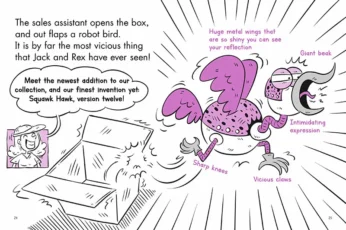
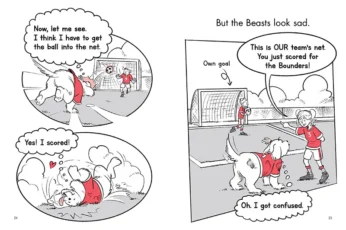
One thing I did notice while reading through both collections is that the Jetpack Jack books can feel a little busier on the page than the Jess and Pip books, with more happening visually in some of the illustrations and panels. This certainly isn’t a negative, and many students will love it, but I mention it because some students can become overwhelmed or distracted when there is a lot happening on a page. If you are working with a student who finds visually busy pages difficult, the Jess and Pip books may be a better place to start. As always, it comes back to knowing the learner in front of you.
The books in this set also contain four full chapters, giving students an opportunity to spend longer reading connected text and build accuracy, fluency, confidence and reading stamina.
The teaching supports, oral-language opportunities, vocabulary and comprehension features I discussed in my first review are also still there, so I won’t repeat all of those details again here.
Moving into the extended code
The biggest difference with this set is that we are now moving further into the extended code.
The books follow the Sunshine scope and sequence. If you are teaching from that sequence, the books should naturally align with what your students are being explicitly taught.
However, many DEB members will be using a different scope and sequence, particularly when working with dyslexic students in intervention, so I would always check each book against what the individual student has actually been taught.
The Sunshine scope and sequence uses a speech-to-print approach to phonics, starting with the phoneme (sound) and then teaching the different graphemes (letter patterns) that can represent that sound. The sequence moves through these relatively quickly.
For children who are ready for a faster pace of acceleration, I can see this being a real advantage. We don’t want to unnecessarily hold back a student who has secure decoding knowledge and is ready to move forward.
This is also where David Share’s self-teaching hypothesis is relevant. As students become increasingly proficient at decoding, successful encounters with unfamiliar written words can contribute to the development of word-specific orthographic knowledge. These books provide lots of opportunities for those students to apply their existing knowledge to increasingly complex words within longer connected text.
For dyslexic students, however, the pace may need to look quite different.
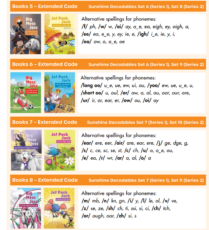
Long /ā/ is a good example. There are seven grapheme patterns for long /ā/ included at this stage. For a dyslexic student who is only just beginning to learn long vowels, I personally wouldn’t introduce all seven at once. That can be a lot of new information to learn, remember and retrieve.
I would break them into smaller groups, slow the teaching down and provide plenty of explicit teaching, practice and cumulative review before introducing more.
This isn’t about one pace being right and another being wrong. Different learners need different rates of acceleration.
The resource is the tool – and knowledge matters
This is probably my biggest consideration when thinking about these books for older dyslexic students.
The books are the resource, the tool. The expertise comes from the person using them.
Once we move beyond the basic code and into long vowels, more complex orthographic patterns and morphology, the knowledge of the person teaching becomes increasingly important.
I noticed, for example, words containing suffixes such as -ing, -less and others that I couldn’t clearly see addressed within the scope and sequence. There are also words where adding -ing involves a spelling change, including doubling the final consonant.
Knowing how to decode the individual graphemes doesn’t necessarily mean a student understands the morphological structure of the word or the spelling convention involved.
A student may need to be explicitly taught to identify the base word and suffix, understand the meaning of the suffix and learn what happens to the spelling when that suffix is added. These are often areas where dyslexic students need additional explicit teaching and support.
I couldn’t clearly see where these areas are addressed within the Sunshine scope and sequence. That doesn’t mean they aren’t covered elsewhere within the programme, but it is something I would want teachers and tutors to be aware of when using these books.
This is where specialist knowledge really matters.
A teacher who understands dyslexia and the English orthographic system can look beyond the book and decide what that particular learner needs. They may slow down a group of graphemes, provide additional cumulative review, explicitly teach a spelling convention, bring in morphology or spend more time exploring a base word and its affixes.
For another student with secure decoding skills who is ready to accelerate, the same teacher may decide that none of that additional support is needed at that point.
One thing I would strongly recommend when using these books with a dyslexic student is to read the book yourself first. Identify the vocabulary you know your student is likely to need support with and decide what needs to be explicitly taught before they begin reading.
Pre-teaching this vocabulary will be invaluable, particularly as students move into more complex parts of the English orthographic system. This is also where the teacher may need to make decisions about how particular patterns are taught.
For example, when students encounter words containing -tion, -cian, -sion or -cious, you may choose to teach these through a phonics approach, looking at correspondences such as <ti>, <ci> or <si> representing /sh/ in particular contexts, as they are approached in the Sunshine sequence. Alternatively, you may teach larger final units such as -tion, -cian, -sion and -cious, similar to the way these have traditionally been taught in Orton-Gillingham-based approaches. As students’ knowledge develops, you may also explore these words morphologically, looking at meaningful suffixes such as -ion and -ous and the base words they attach to.
These are simply examples of the different ways a knowledgeable teacher may approach the same words. The important point is understanding what you are teaching, why you are teaching it that way, and what approach best supports the learner in front of you. The book provides the reading practice, but the teacher brings the knowledge needed to decide what requires explicit teaching before the student encounters it in the text.
This is another reason why knowing your learner matters. What needs to be pre-taught will be different for every student, depending on what they already know and where the gaps are in their learning.
That is why I can see these books working well with dyslexic students in the hands of an experienced specialist teacher. It isn’t simply about following a scope and sequence from beginning to end. It is about understanding the learner, recognising where the gaps are and having the knowledge to provide the additional teaching when it is needed.
My overall thoughts
I really liked the first Sunshine Reading Adventures books, and this next set hasn’t changed my opinion.
They are still engaging, beautifully illustrated books with interesting stories, familiar characters and plenty of opportunities for students to develop their reading.
For students who are ready to accelerate, I can see the faster progression through the extended code being a real strength. For dyslexic students, particularly older students still developing their knowledge of the extended code, I would adapt the pace and teaching to suit the individual learner.
Ultimately, that is what I keep coming back to with this set: know the learner in front of you.
In the hands of a specialist teacher who understands dyslexia and the English orthographic system, I think there is plenty of flexibility to adapt these books to suit the student rather than expecting the student to fit the resource.
Used thoughtfully, I think they can provide another great opportunity for students to practise their decoding while reading longer, engaging and age-appropriate stories and continuing to build their fluency, stamina and confidence as readers.
Ben is still making his way through the books, and he is still laughing out loud and genuinely enjoying them, which for me says a lot.
I have no hesitation recommending these books to DEB members. I think they are engaging, well-designed and good value for money, and I would happily recommend them to parents, teachers and tutors looking for decodable books that allow students to progress into longer, more engaging texts.
However, I really can’t emphasise enough the importance of knowing the learner in front of you. The resource is the tool, and how you use it matters. For some students, the pace through the extended code will be exactly what they need. For others, particularly dyslexic students, you may need to slow things down, pre-teach vocabulary, provide additional explicit teaching and cumulative review, and bring in morphology and spelling conventions where needed.
Adapt the resource to the learner rather than expecting the learner to fit the resource.
For more detail about the illustrations, teaching supports, vocabulary, comprehension, oral-language opportunities and my thoughts on the overall series, you can read my original review here:
Sunshine Books Reading Adventures – Decodable Graphic Novels Review
Disclaimer
Sunshine Books paid me for this review. However, I want to be transparent that payment does not influence or change my opinions about a resource.
As a parent, maintaining trust and integrity around the resources I recommend is extremely important to me. I will only review resources that I believe are research-informed, align with structured literacy principles and the values DEB advocates for, and that I genuinely feel could benefit DEB members, educators and families supporting children with literacy difficulties.
Written by Sharon Scurr Founder of Dyslexia Evidence Based 25 September 2026