
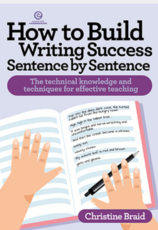
How to Build Writing Success Sentence by Sentence
Author: Christine Braid
Overview
This review looks at How to Build Writing Success Sentence by Sentence by Christine Braid and whether it is a useful resource for parents, educators, and intervention settings.
This book focuses on one of the most important foundations of writing — the sentence. Just like reading has an underlying code (the alphabetic code), writing also follows a structure. Understanding how sentences work, and how to build them step by step, is key to developing confident writers.
The book takes a structured approach, starting with simple sentence construction and gradually building toward more complex writing through the use of phrases and clauses.
What I liked
Clear, structured progression
The book breaks sentence writing down into manageable steps. Each part of a sentence is clearly explained, helping build understanding in a logical order.
Practical and usable
There are plenty of examples, activities, and ideas that can be used straight away with children — whether at home or in the classroom.
Accessible for parents and teachers
The language is clear and easy to follow. It is not overly academic, which makes it a good option for parents who want to support writing at home as well as educators.
Realistic and supportive tone
There are helpful reminders about common pitfalls and unhelpful habits, alongside guidance on what to do instead. This keeps the approach practical and encouraging.
Who this resource is for
- Parents wanting to better understand how to support writing at home
- Teachers looking for practical, classroom-friendly ideas
- Those new to sentence structure, grammar, and writing instruction
- Intervention settings where writing needs to be broken down into smaller, explicit steps
How to use this resource
This book works best when used as a step-by-step guide, rather than something to dip in and out of.
- Start from the beginning
Each section builds on the previous one. Working in order helps develop a clear understanding of how sentences are constructed. - Go slow and review
Writing takes time to develop, especially for dyslexic learners. It is normal to review earlier sections multiple times to strengthen understanding and confidence. - Use the examples actively
Talk through the examples together. Ask questions like:- What is the subject in this sentence?
- What is the verb?
- What has been added to make the sentence more detailed?
- Apply learning through short, focused practice
For many dyslexic learners, writing can be cognitively demanding. Keep practice short and targeted. One or two well-constructed sentences is far more valuable than longer pieces of writing without clear structure. - Match the level to the learner
In intervention settings, it is important to meet the learner where they are. Some children will need to stay at the simple sentence level for longer before moving into phrases and clauses. This is expected and appropriate. - Use as part of an intervention approach
This resource works well alongside structured literacy and targeted intervention. It supports explicit teaching of sentence construction, which is often an area of difficulty for dyslexic learners. - Pair with explicit teaching and support
Dyslexic learners will benefit from clear modelling, guided practice, and repetition. This is not a resource for independent learning — it works best when used with adult support.
Important considerations
Writing is complex and develops over time. Many children will need to start with the basics — such as:
- Understanding parts of speech
- Using capital letters and full stops correctly
- Building simple sentences
before moving into more complex concepts like clauses and punctuation.
Skipping ahead can make learning harder, as later concepts rely on earlier understanding.
Alignment with structured literacy
This resource aligns well with a structured approach to writing. It reflects key principles such as:
- Explicit teaching of skills
- Breaking learning into manageable steps
- Building from simple to complex
- Providing clear models and examples
It supports the idea that writing, like reading, benefits from systematic and intentional instruction.
Availability
This book is available to purchase through Essential Resources:
https://www.essentialresources.co.nz/Store/Product/Detail/51266
Overall thoughts
This is a practical, easy-to-follow resource that supports the development of writing at the sentence level.
It is the kind of book that would have been incredibly helpful when first learning how to support writing. It provides clarity, structure, and realistic guidance without being overwhelming.
A valuable resource for anyone beginning their journey in teaching writing.
Disclosure
A copy of this book was kindly provided by the author for review. This does not influence the content of this review.
Original source
Original review shared on Facebook on 29 October 2025.
Transferred to the DEB website on 15 April 2026.
This review was created by Sharon Scurr, Founder of Dyslexia Evidence-Based (DEB).