
THE MORPHOLOGY KIT BY LITERACY CONNECTIONS: RESOURCE REVIEW
I recently had the opportunity to review The Morphology Kit from Literacy Connections, and I think this is a great resource.
One of the reasons I particularly wanted to review it is that I feel there has been a lack of practical morphology resources that can also support parents wanting to help their child at home and teacher aides who may still be on their own learning journey.
While The Morphology Kit has been designed primarily as a classroom resource, I could easily see how it could be adapted for small-group or one-to-one intervention.
What stood out to me almost immediately was its simplicity. I particularly liked the videos that support the learning, alongside the clear scope and sequence, word mat and worksheets.
The Morphology Kit covers the basics of morphology in a really accessible way, making it a great place to start. For someone relatively new to morphology, it provides enough information and practical support to begin building your understanding and confidence without making it feel overwhelming.
THE SELF-PACED ONLINE COURSE
One of the real benefits of The Morphology Kit is that you aren’t simply given a collection of resources and expected to work out how to use them.
The kit is supported by a self-paced online course, which includes four videos ranging from around 8 minutes to 20 minutes in length, so they are easy to work through without feeling overwhelming.
The videos cover:
- An Introduction to Morphology
- An Overview of the Resource
- The Morphology Lesson
- Planning and Assessment
Alongside these are the practical teaching materials, including a scripted lesson template, slideshows, worksheets and additional resources.
I really like the self-paced format. You can work through the learning in your own time and, importantly, go back and review the videos whenever you need to.
You can watch the teaching, begin using the resource and then return to a video when you need a refresher. For parents, teacher aides, home schoolers and educators fitting this learning around everything else they are doing, I think that is incredibly practical.
THE SCOPE AND SEQUENCE
The Morphology Kit provides a clear scope and sequence spanning Years 0–8.
It starts with simpler morphology and progressively builds towards more complex prefixes, suffixes and bases as students move through the year levels. For example, students move from the plural suffix -s, to prefixes such as re-, and then into bases such as spect and graph.
I really like being able to see this progression laid out clearly. It takes away some of that initial question of, where do I actually start?
Particularly when using the resource for intervention, however, I wouldn’t necessarily be guided by the year level alone. I would look at the knowledge and needs of the learner in front of me and use the scope and sequence as a guide for where to begin and what to build towards.
THE SLIDESHOWS AND EXPLICIT TEACHING
The Morphology Kit includes 12 comprehensive slideshow templates covering a mixture of prefixes, suffixes, and base words across different year groups.
They are designed to support the “I do, we do” component of explicit instruction, particularly for whole-class teaching. Importantly, they are templates that teachers can copy and edit to meet the needs of their own students.
The kit also includes a scripted lesson template, which I think is extremely valuable, particularly when you are first starting out teaching morphology.
The template provides a scaffold for what a lesson can actually sound and look like. Rather than having to work everything out yourself, you have a structure and language to work from that can then be adjusted for the particular concept or morpheme you are teaching.
For someone still building their own knowledge and confidence with morphology, I think this is a great scaffold. As your confidence grows, you can adapt the template and make the lesson your own.
Combined with the slideshow templates, you aren’t just being given what to teach. You are also being given practical support for how to teach it, which I think is one of the real strengths of this resource.
MORPHOLOGY CARDS
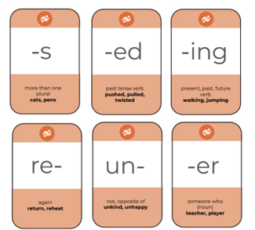
Another really practical part of The Morphology Kit is the set of morphology cards.
The cards include prefixes, suffixes and bases, along with their meanings and examples, progressing from morphemes such as -s, -ed, -ing, un- and re- into a much wider range of affixes and bases.
I can see these becoming an ongoing teaching and review tool. They can be added to a sound pack in the classroom as each morpheme is explicitly taught or incorporated into the sound pack used during small-group or one-to-one sessions.
This provides an easy way to continually review previously taught morphology alongside phonics knowledge and build it into the cumulative review already happening within a Structured Literacy lesson.
THE WORD MAT
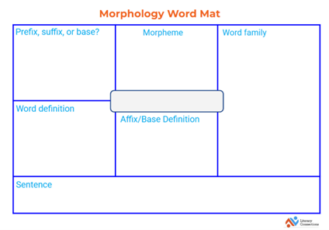
The Morphology Word Mat is simple, but I think it is really useful.
Rather than simply learning a list of prefixes, suffixes or bases, students explore the morpheme, its meaning, its word family, the definition of the whole word and then use the word within a sentence.
For example, using the word spectacular, students can explore the base spect, meaning “to look or see,” and then investigate related words such as spectator, spectrum, spectacles, retrospect and inspect. This helps students see that these aren’t simply a collection of unrelated words. They share a meaningful base and understanding that base gives students another way to see how words are connected and to begin making sense of unfamiliar vocabulary.
I particularly like this because it moves morphology beyond simply identifying a prefix, suffix or base. Students are building word families, vocabulary, and an understanding of how words are constructed and connected through meaning.
For older students in intervention, I think this can be particularly valuable. They are increasingly encountering more complex vocabulary across subjects such as science, maths and social sciences, so helping them understand the meaningful parts within words can support both their literacy and their understanding of curriculum vocabulary.
THE WORKSHEETS
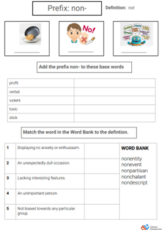
The Morphology Kit includes 77 pages of worksheets, providing plenty of opportunities for students to practise and review the morphology concepts taught across the scope and sequence.
The worksheets are designed to come after the explicit teaching. They are not intended to teach the morphology concept themselves. The teaching happens first, with the worksheets providing an opportunity for students to practise, review and show that they have understood what has been taught.
In other words, they sit within the “you do” part of the lesson once the teacher has explicitly modelled the concept and worked through it with the students.
The earlier worksheets review concepts such as plural -s, the different sounds represented by -ed, -ing, and common prefixes such as re- and un-. As students move through the scope and sequence, the worksheets provide review and application of the increasingly complex morphology they have been explicitly taught.
I think that distinction is really important, particularly for parents or anyone new to morphology. The worksheet isn’t the lesson. It is a way of checking and consolidating the learning that has already taken place through explicit teaching.
The kit also includes answer sheets for the worksheets, which I think is particularly useful for parents or anyone still developing their own confidence with morphology.
WHAT ABOUT ONE-TO-ONE INTERVENTION?
This was the main area I wanted to explore further as I worked through The Morphology Kit.
I can see it having real value for teacher aides, parents and home schoolers working one-to-one with a learner, but intervention can look quite different from a whole-class morphology lesson.
An older student, for example, may be able to read many of the words but have considerably more difficulty spelling them or analysing their structure. For that learner, I might spend less time reading the words and more time building, segmenting, spelling and explaining them.
I may also spend much longer in the “we do” part of the lesson before expecting independent work or shorten a dictation sentence for a learner who struggles with working memory.
I would also be mindful of the student’s existing knowledge of the phonics code. If I am asking a student to spell words, I want to consider whether the phoneme-grapheme correspondences within those words have already been explicitly taught.
For me, this is about adapting the resource to the learner sitting in front of you.
LITERACY CONNECTIONS’ RESPONSE TO MY FEEDBACK
I raised the one-to-one intervention aspect with Literacy Connections because I thought it would be particularly helpful for parents to actually see what an individualised lesson could look like.
I was really pleased with their response.
Literacy Connections have offered to create an additional video demonstrating a more individualised, one-to-one lesson using The Morphology Kit, particularly with parents in mind.
In the meantime, they have also said that parents using The Morphology Kit are very welcome to contact them directly if they need additional support or would like to talk through using the resource with their child.
I really appreciated how receptive they were to the feedback and their willingness to provide that additional support.
WHO MORPHOLOGY KIT WOULD SUIT?
Although designed primarily as a classroom resource, I can see The Morphology Kit being useful for:
- classroom teachers
- teacher aides
- tutors and intervention staff
- home schoolers
- parents wanting to support their child at home.
For someone thinking, I know morphology is important, but I really don’t know where to start, I think this provides a very accessible entry point.
VALUE FOR MONEY
The Morphology Kit costs $145, and I think this is excellent value for money for what is included.
You are getting the self-paced online learning with four videos, the scope and sequence, morphology cards, word mat, 77 pages of worksheets and the accompanying answers, planning and assessment support, a scripted lesson template and 12 editable slideshow templates.
These are resources that can be used, reused and adapted across different year levels and teaching situations.
At $145, I think The Morphology Kit represents excellent value for the amount of teaching support and practical resources included.
MY OVERALL THOUGHTS
Overall, I think The Morphology Kit is a great resource.
For me, its biggest strength is that it makes the basics of morphology feel accessible. There is enough support for someone who is still learning themselves, while also providing practical resources that can be adapted for the classroom, small-group teaching or one-to-one intervention.
I particularly like that Literacy Connections were receptive to my feedback around supporting parents with one-to-one teaching and have offered to add a video demonstrating what this could look like.
For $145, with the amount of learning, teaching support and reusable resources included, I think it is excellent value for money. I am very happy to recommend The Morphology Kit and add it to the DEB Programmes and Resources section. I think this is a resource that will be valuable for teachers, teacher aides, tutors, home schoolers and parents.
TRANSPARENCY
For transparency, Literacy Connections gifted me access to The Morphology Kit so I could independently review the online resource and determine whether I felt it was suitable to recommend to DEB members.
There was no requirement for me to provide a positive review, and the views and recommendations in this review are my own.
This review was written by Sharon Scurr Founder of Dyslexia Evidence Based on the 28 August 2026