
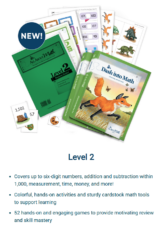
Review on All About Math Level 2
The maths version is designed to support foundational learning k-5years (roughly Years 1–6 in NZ). It’s important to note that it is not specifically designed for children with dyscalculia, just like All About Reading and All About Spelling are not designed specifically for dyslexic learners.
However, because of the approach to teaching, which is multisensory, systematic, diagnostic and explicit, it will support children who are struggling with maths.
I’ll be honest, I’ve been really keen to get my hands on this programme ever since I heard about its release.
I chose to review Level 2, because this is where many of the core maths skills really start to build, but only once a child has developed subitising.
Subitising is the ability to recognise how many items are in a small group without needing to count them (for example, instantly knowing there are 3 dots on a dice without counting 1, 2, 3). This is a key foundation for number sense.
Subitising develops in two stages:
- Stage 1: Perceptual subitising
This is when a child can instantly recognise small quantities (usually up to 3 or 4) without counting. This is the main focus of Level 1, helping children build that immediate recognition of number.
- Stage 2: Conceptual subitising
This is when a child can see a larger group and understand it as smaller parts within a whole (for example, seeing 5 as 3 and 2, or 4 and 1). This stage is critical because it underpins addition, subtraction, and place value.
Level 1 focuses on building Stage 1, and some of stage 2. Level 2 continues to build on Stage 2. Once this is secure, children are in a much stronger position to move into addition, subtraction, and place value with understanding, rather than just memorising.
There is a real gap in the market when it comes to parent-friendly maths programmes that are still comprehensive, evidence-based, and can be used as an intervention option for children who need extra support at home. That combination is surprisingly hard to find.
Like many parents, I’ve tried far too many maths programmes over the years, and yes, it has cost me a pretty penny along the way. One programme I love and use is Saxon Math, but it’s not as accessible in New Zealand as it was five years ago and postage from the US makes it too expensive now.
That’s why I was really interested in seeing whether All About Math could help fill this gap, especially for parents supporting children who are struggling with maths or may have dyscalculia.
What I Love
- Evidence-based approach
This is a big one for me. It aligns with what we know from the science of learning and maths instruction, something that is often missing in many parent-focused programmes.
- Sequential, systematic and the structured progression
The content is taught in a clear order, moving from the easiest concepts through to more complex ones. This matters because maths builds on prior knowledge nothing is left to chance.
- Scripted lessons for explicit teaching. The inclusion of scripted lessons is a real strength. It supports parents to teach concepts explicitly and clearly, even if they don’t have a teaching background. This helps reduce guesswork and ensures consistency in how concepts are introduced.
- User-friendly teacher’s manual (written for parents)
This really stands out. The teacher’s manual is clearly designed with parents in mind, making it easy to follow and use at home. Each lesson is laid out step-by-step and includes exactly what you need, such as the page numbers for activities, required materials, and the specific flashcards to use. This level of clarity makes it far more manageable and less overwhelming for parents.
- Everything is included (no printing needed)
Everything you need is included in the programme (apart from the materials), which I really appreciate. You don’t need to print anything out, which is a big plus for busy families.The only thing to be aware of is that you do need to be organised and prepared to cut out the activities, so having a system for this will make things much easier.
- Flexible lesson length (designed for real families)
Each lesson includes maths vocabulary, review, new teaching, and an activity, but I really appreciate that the programme recommends lessons be around 20 minutes, and for some children, even 10 minutes. It’s very much about what works for your child, which I think is important. The lessons are designed to be completed over a few days, you’re not expected to finish a lesson in one session, so it’s absolutely okay to pause and come back to it.
- A clear 3-step process for solving problems
I really appreciate the structured 3-step process the programme uses to break down maths problems, even at this early stage. This is important because one of the biggest challenges many children face is understanding and solving word problems. Having a consistent process helps reduce overwhelm and gives children a clear pathway to follow.
- Built-in review in every lesson
Each lesson includes a built-in review, which is really valuable. It allows you to clearly see whether your child has mastered the skill or if they need more practice before moving on. This kind of ongoing check-in supports better learning and helps avoid gaps forming over time.
- Progression check-in sheet (highly recommend using this)
The activity book includes a really useful progression check-in sheet. You record the date a skill was introduced and the date it was mastered. This becomes incredibly valuable over time. For example, if you realise 5–7 lessons later that a skill wasn’t actually secure, you can go back, reteach it, and then record the new mastery date. This helps you clearly see patterns, whether your child is struggling with a specific skill, or if the challenge might be related to vocabulary, comprehension, or moving on too quickly. It takes the guesswork out and can give you a much clearer picture of what’s really going on.
- Explicit maths vocabulary in every lesson. Each lesson clearly lists the maths vocabulary, which is so important. This is an area where many children struggle, especially when they don’t fully understand the language being used. I really like that there are no nicknames or simplified terms, the correct mathematical language is used from the start. This helps build understanding and will support your child’s learning as maths becomes more complex in later years.
- Clear lesson structure with built-in support and extension
Each lesson follows a clear structure: review, new teaching, and extended practice (if needed). This makes it easy to follow and ensures concepts are revisited before new learning is introduced. I also really like that there are tips included to support or extend learning, depending on the child. This makes it more adaptable and helps meet the needs of different learners without losing the structure of the programme.
- Strong focus on place value (revisited consistently)
Place value is a key foundation in maths, and I really like that it is covered again and again across lessons. This repetition helps ensure children truly understand the concept, rather than just learning it at a surface level. This kind of depth is critical because without a solid understanding of place value, many later maths concepts become much harder.
- Activity book as a strong companion (with engaging practice)
The activity book is a great companion to the lessons, providing extra practice in a way that feels engaging rather than repetitive. The activities use a range of themes such as birds, gumball machines, road signs, and games which helps keep children interested and motivated. Many of the games can be played multiple times, and for activities that require writing, they recommend using a plastic sleeve so pages can be reused. This makes it both practical and cost-effective.
Where Some Learners May Need Extra Support:
- Layout of maths problems (horizontal vs column format)
The maths problems are often presented horizontally (across the line – algorithm) rather than in place value columns. For some learners, this can make it harder to keep numbers aligned and understand place value. I would recommend rewriting the sums into column format on the activity sheet, or using a maths workbook (for example, one with larger squares) to help keep numbers organised. This can make a big difference for children who need more visual structure. - US-based money content (needs adapting for NZ)
As this is a US programme, the money section will need some adapting. The main difference is with coins: our notes are aligned in value, but the coin system is different. What I’ve done when using other US-based programmes is simply swap it out using plastic or real NZ money. For example, if the question asks, “How many quarters make a dollar?” I would change it to, “How many 20 cent pieces make a dollar?”
- The key concept—place value and understanding that 100 cents = 1 dollar—remains exactly the same, so it’s an easy adjustment once you know to do it.
- Pace may still feel too fast for some learners. Even with the strong structure and built-in review, some children, particularly those with more significant maths difficulties or severe dyscalculia, may need more time, repetition, and smaller steps than what is provided within the lessons. There are a few tips included in the programme, but I would recommend that if you see your child starting to struggle, pause at that lesson and spend more time reviewing the skill before moving on.
- For example, if the focus is on addition or subtraction, you can reinforce this through different activities, such as using a pack of cards, UNO cards, dominoes, or dice to give more practice in a way that feels manageable and engaging.
- Word problems and language demands
While the programme includes a clear structure for solving problems, some children may still find word problems challenging, especially if they have underlying difficulties with language, vocabulary, or comprehension. It’s important to make sure your child understands all the words in the problem before expecting them to solve it. Although the programme includes images to support most of the word problems in the activity pages, some learners will still need help breaking down the language first before applying the maths. These learners may need additional support to unpack the wording step by step so they can focus on the maths itself.
- Working memory/Cognitive load
Some learners may struggle to hold and process multiple steps at once. Even with explicit teaching, they may benefit from extra scaffolding, such as visual supports, writing steps down, or reducing the number of steps introduced at one time. This is something we see across all maths programmes, but I wanted to include it here as an important consideration for parents to keep in mind.
- Generalisation of skills
Some learners may be able to complete tasks within the structured lesson but struggle to apply those skills in new or less familiar contexts. This is not unique to this programme, but something we often see in maths learning more broadly. These learners may need additional support to transfer what they’ve learned beyond the programme.
Cost (and what that looks like over time):
I know a few people might look at this programme and think it’s costly, around $220 for the books and $210 for the materials kit.
But when you break it down, it looks a bit different. If you take the $220 for the books and spread that across 40 weeks (an average school year), it works out to about $5.50 per week.
For the level I’m reviewing, I actually already had most of the materials at home, and you may as well. Things like a ruler, small objects (teddies, animals, LEGO), counters, connecting cubes, a whiteboard or sketch board, and plastic sleeves. There’s nothing overly specialised, and all materials are listed in the teacher’s manual.
The materials kit itself is designed to cover K–5 in the US (roughly Years 1–6 in NZ), so when you look at it over time, it works out to about $35 per year, paid upfront.
If you’re not in a position to afford a tutor, and you have a child who is willing to work with you at home, this becomes a very affordable option.
Maths at the foundational level follows a logical sequence, so it should be relatively straightforward to align what you’re doing at home with what is being taught at school.
Disclosure:
Krystel Watts from Engaging Minds NZ was kind enough to send me this programme for review, and I will return the kit to them.
That said, I am seriously considering switching from Saxon Math to All About Math with Ben. Before making that decision, I want to review the scope and sequence in more detail and confirm which skills are covered at each level.
I’m very comfortable recommending this programme to parents, provided you take the time to read this review and understand that some adaptations may still be needed, particularly for children with more significant challenges in foundational maths.
Overall, I think this is a strong option for families, especially when used with an understanding of your child’s individual needs.
My Background and Experience:
My understanding of maths instruction comes from a combination of professional learning and real-life experience. I’ve completed Marilyn Zecher’s Multisensory Maths training US based, which focuses on foundational maths for struggling learners, as well as the Learning Matters multisensory math course and Numicon training.
I also follow the work of researchers and practitioners such as Daniel Ansari, Steve Chinn, and Ronit Bird, whose work has shaped how we understand maths difficulties and effective teaching approaches.
Alongside this, I’ve spent years teaching maths at home, particularly supporting my own son using Saxon Math, who has severe dyscalculia (with a mild intellectual disability). That experience has required me to explore, trial, and adapt a range of different programmes and approaches to find what actually works in practice. I have also created my own math scope and sequence for my son to cover foundational and real-life math skills.
While this review on All About Math, is based on my experience, it’s also grounded in evidence and a broader understanding of how children learn maths, what can go wrong, and what tends to help.
Link to Sample pages, Scope and Sequences can found by clicking on each level –
Link to Facebook post with screen shots from the books
Link to Engaging Minds where this programme can be purchased in New Zealand
Created by Sharon Scurr for Dyslexia Evidence Based Community on the 6th of April 2026