
Calling Structured Literacy “Just Phonics” Misses the Point
One of the most common statements I continue to hear is:
“Structured Literacy is just phonics.”
I understand why people say it. Phonics has become the most visible part of the conversation as New Zealand has renewed its focus on evidence-informed literacy instruction.
Reducing Structured Literacy to “just phonics” overlooks the breadth of the framework and the knowledge required to implement it effectively.
Before we debate whether Structured Literacy is good or bad, I think we should first ask a simple question:
Do we actually understand what Structured Literacy is?
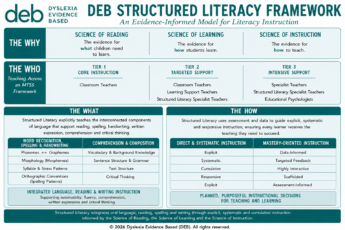
Structured Literacy is a framework
Structured Literacy is not a commercial programme.
It is not a script or a worksheet.
It is an evidence-informed framework for explicitly, systematically and cumulatively teaching spoken and written language. At its core, it brings together what we know about language development, literacy development and effective teaching to help teachers understand what children need to learn, how learning develops over time and how instruction can best support success.
What does Structured Literacy include?
The framework encompasses:
- Oral language development
- Speech production
- Phonological awareness
- The alphabetic principle (phonics)
- Orthography
- Morphology
- Vocabulary
- Syntax
- Semantics
- Reading fluency
- Reading comprehension
- Spelling
- Written expression
- Composition and academic writing
- Critical thinking
These components are interconnected and build upon one another. Foundational skills support increasingly sophisticated reading, writing, communication and thinking.
The alphabetic principle and phonics
The alphabetic principle is the understanding that letters and letter combinations represent the sounds of spoken language.
Phonics is the explicit instruction that helps children learn and apply that principle.
That distinction matters.
Phonics is an essential part of Structured Literacy, but it is not the framework itself.
Describing Structured Literacy as phonics is a little like describing mathematics as multiplication tables. Multiplication is essential, but no one would argue it represents the whole of mathematics.
Looking beyond the Science of Reading
One reason Structured Literacy is often misunderstood is that discussions frequently focus only on the Science of Reading.
The Science of Reading is essential, but it is not the whole picture.
Effective Structured Literacy is strengthened by three complementary bodies of evidence:
The Science of Reading
Helps us understand how reading develops and the knowledge children need to become skilled readers.
The Science of Learning
Explains how memory, attention, cognitive load, retrieval practice, feedback and knowledge-building influence learning.
The Science of Instruction
Helps teachers design effective teaching through explicit instruction, systematic sequencing, cumulative review, responsive assessment and appropriate scaffolding.
Three fundamental questions
Together, these three sciences answer three fundamental questions:
- What do children need to learn?
- How do children learn most effectively?
- How should we teach to maximise learning?
Understanding language without understanding learning is not enough.
Understanding learning without understanding instruction is not enough.
It is the combination of all three that enables teachers to make informed decisions for the children sitting in front of them.
The conversation we’ve been missing
This is why I believe we’ve been having the wrong conversation.
For too long, we’ve debated phonics and programmes while overlooking the thing that matters most—Teacher knowledge.
What expert teachers know
Good Structured Literacy teaching demands far more than teaching letter-sound relationships.
Teachers need deep knowledge of language, including:
- Phonology
- Orthography
- Morphology
- Syntax
- Semantics
- Vocabulary
- Spelling
- Writing
They also need to understand how children learn through concepts such as:
- Cognitive load
- Explicit instruction
- Retrieval practice
- Cumulative review
- Assessment
- Responsive teaching
Most importantly, they need the professional judgement to know when to adjust instruction to meet the needs of the individual child sitting in front of them.
That isn’t scripted teaching.
That is expert teaching.
What about critical thinking?
Another misconception is that explicit teaching somehow limits critical thinking.
I believe the opposite is true.
Critical thinking depends on knowledge.
Children cannot evaluate evidence, identify bias, compare perspectives or construct a reasoned argument if they are using most of their mental effort trying to decode the words on the page.
As reading becomes accurate and increasingly automatic, children can devote more of their thinking to understanding, questioning and analysing ideas.
Strong vocabulary, language knowledge and background knowledge are what allow critical thinking to flourish.
Teaching children how to read does not replace critical thinking.
It gives them greater access to it.
Words shape understanding.
Why words matter
When Structured Literacy is repeatedly described as “just phonics”, people are left with the impression that classrooms are focused only on teaching letter sounds.
They overlook the rich work involved in language development, vocabulary, morphology, comprehension, writing, academic writing and critical thinking.
More importantly, they overlook the professional expertise required to bring all of these elements together.
Healthy debate starts with understanding
I welcome healthy debate about education. In fact, I think we need more of it.
But meaningful debate begins with an accurate understanding of what we’re debating.
Reducing Structured Literacy to phonics creates a simplified version of the framework that is much easier to criticise than the real thing.
A final thought
So, the next time someone says, “Structured Literacy is just phonics.”
I would encourage them to pause.
Look beyond the label.
Explore the framework.
Read the evidence.
When we do, we discover that Structured Literacy is far more than phonics.
Structured Literacy doesn’t end with phonics; it begins there.
Written by Sharon Scurr 16 July 2026