
Reflections from the Numicon Conference: What Real Pedagogical Change Looks Like
At the recent Numicon conference, I attended a workshop where two Christchurch schools shared their experiences of implementing Numicon within their settings.
Kerri Anngow and Chris Panther (principal) from Waimairi School presented first, followed by Rhys Williams from Mairehau School, who was presenting on behalf of his principal, Nicholas White, who was unable to attend. Nicholas had originally led the school’s learning journey and implementation of Numicon.
Both presentations were honest and reflective, offering real insight into what meaningful change looks like in schools.
From Intervention to Whole-School Practice
Like many schools, Waimairi and Mariheua had previously engaged with Numicon in a limited way. It had been used in pockets, often to support students who were experiencing difficulty. Over time, this led to an unintended consequence, the Numicon materials became associated with “special needs” support rather than as a tool for all learners. This is a pattern seen across many initiatives in education. When staffing changes occur, training knowledge can be lost, and resources, no matter how valuable, can end up unused.
Leading Change: A Shared Journey Across Schools
While Waimairi School and Mairehau School presented their journeys separately, the message coming through from both was consistent, and importantly, it felt real.
These were not polished, perfect stories. They were honest reflections of what it actually takes to shift practice in a school.
Kerri spoke openly about her own journey as a teacher initially attending Numicon training to better support students in her class who were struggling. What became clear to her over time was that this was not just about helping a small group of learners.
This is not just an intervention, it is a whole-school approach to teaching mathematics
From Mairehau School, Rhys Williams reinforced a similar message, sharing how their journey had also required a shift in thinking not just in what they were doing, but in how they understood mathematics teaching.
Across both presentations, there was a shared understanding:
This was not about introducing a programme it was about shifting practice.
Creating the Conditions for Change
What stood out across both schools was how deliberate they were in creating the conditions for change. For both schools, this journey began in 2023. It was not rushed, it was built deliberately over time, and they are still learning. Both schools spoke about the importance of:
- Leadership – Strong and courageous leadership sat at the centre of this shift. Decisions were made with clarity and purpose, and leaders remained consistent in their direction.
- Professional Learning – Professional learning was prioritised for all staff. This was not optional; it was a shared commitment across the school.
- In School Training Support – Training did not sit outside the classroom. Trainers from Numicon were brought in to support the change, allowing teachers to learn within their own practice.
- Resourcing – Both schools invested money in materials across all classrooms, reinforcing that this approach was for all learners, not just for intervention and the resources were a crucial part of the success they are seeing.
- Staff Attitude and Mindset – This was a key focus. A common statement heard in many schools is: “I’m not good at maths.” This was not ignored, it was addressed. The expectation was clear: Lead with enthusiasm.
Because what teachers believe about mathematics will show up in their teaching, and students will pick up on it.
Allowing Teachers to Learn
One of the most powerful messages across both presentations was the recognition that this kind of change takes time. Both schools acknowledged that what they were asking teachers to do was significantly different from what they had done before.
This required:
- Letting go of familiar approaches.
- Building new knowledge
- Learning new ways of teaching
- Trusting the process
Importantly, teachers were given permission to learn. Permission to:
- Not have everything figured out immediately.
- Learn alongside their students.
- Work through uncertainty.
- Build confidence over time.
This stood out, because too often, teachers feel they are expected to already know, rather than being supported as learners themselves. Both schools created space for this process, recognising that developing new practice is not immediate. It takes time, support, and consistency.
Strong Alignment with Structured Literacy
An important observation from both presentations was how closely this approach aligned with structured literacy practices already in place.
Key parallels included:
- A clear scope and sequence
- A whole-school approach
- Explicit teaching
- Ongoing assessment to identify gaps
This highlights an important principle: Effective teaching approaches share common foundations across learning areas.
Understanding the Learning Journey
Chris also revisited what he described as an “oldie but a goodie”. The Four Stages of Competence, a model developed by Noel Burch. I really connected with this image, as it clearly captures how difficult and long the learning journey can be when making a pedagogical shift, whether in structured maths or structured literacy. I believe it will resonate with both teachers and parents, helping build understanding of what this process truly involves.
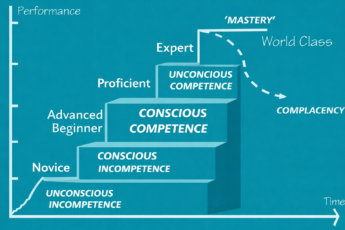
This version of the model shows the progression from:
- Unconscious Incompetence (Novice)
“I don’t know what I don’t know.” - Conscious Incompetence (Advanced Beginner)
“I can see what I don’t know.” - Conscious Competence (Proficient)
“I know what to do, but I have to really think about it.” - Unconscious Competence (Expert)
“I can do this without thinking, it’s becoming automatic.” - Mastery
“I can adapt, apply, and support others.”
What stands out clearly is that the stages are not equal. The step into conscious competence is significantly larger than the others. This stage was referred to by Waimairi School as “the ouch step,” while Mairehau School described it as “being stuck in the pit.” After hearing both schools describe this stage so clearly, I adapted the model slightly making the third step larger to better reflect the reality of the learning process.
It is the stage where:
- You know what to do, but it requires hard work, time and effort to learn new things.
- Teaching feels slower and more deliberate.
- Confidence is still developing.
It is the hardest part of the journey, and often the longest and one you will go in an out off.
Both schools also highlighted that, with the curriculum changes introduced in October 2025, they felt they were beginning to move out of this stage but found themselves back in it again. As they work together to align scope and sequence with the curriculum, they are doing so carefully, ensuring that they do not skip the crucial mathematical knowledge and skills students need in order to progress.
Importantly, the model also highlights the risk of complacency. Even as confidence and expertise grow, ongoing reflection and learning remain important. Learning is not linear. Movement between stages can shift as understanding deepens, practice improves, and new challenges are introduced.
This is a powerful reminder that learning, and change is not a straight path and both schools agree with the change to structured math, but not the speed of the changes and expectations’ I think that is a really important message.
My Thoughts
The experiences shared by both schools reinforce an important message: Sustainable change in education is not about adopting a programme. It is about:
- Leadership
- Professional learning
- Resourcing
- Shared understanding
- Mindset
- And time
It also requires a willingness to stay in the most challenging phase of learning. where it feels hard, but real growth is happening. This is where meaningful, lasting change occurs.
I felt privileged to hear these stories and wanted to share them because it is so important to understand that this is a shift. It takes time, and it is an ongoing journey of learning, not a one-and-done approach.
These schools also deserve to be recognised and celebrated for the work they are doing. Both shared that they are open to others visiting, learning, and seeing their practice in action, a reflection of the collaborative approach needed to support meaningful change.
Sharon Scurr , Founder of Dyslexia Evidence Based