
Working Memory, Dyslexia, and ADHD: Understanding Their Role in the Science of Learning
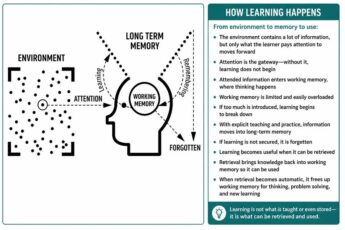
Working memory plays a critical role in how children learn. To understand why it matters, we first need to understand where working memory sits within the Science of Learning and what happens to information as a child learns.
The Science of Learning helps us understand how the brain processes, stores, and retrieves information, and why understanding how we teach is just as important as what we teach.
The diagram below shows this learning process. Information from the environment must first gain our attention before it can enter working memory. From there, new learning can become established in long-term memory and, importantly, retrieved again when we need to use it.
There is a huge amount of information around us at any one time, but only a small amount moves forward. Attention is the gateway to learning. If a learner does not attend to information, it does not enter working memory, and the learning process cannot really begin.
Working Memory: Where Thinking Happens
Once information has our attention, it enters working memory.
Working memory allows us to temporarily hold information in mind while thinking about it or doing something with it.
A child uses working memory when they are:
- holding sounds in mind while blending a word
- remembering the steps of an instruction
- thinking about what they want to write while forming a sentence
- doing mental maths
- holding information from the beginning of a sentence while reading what comes next.
Think of working memory as being like a Post-it note. There is only so much space available to work with at one time. Once the Post-it note is full, there is little room for anything else. When too much information is introduced at once, some information may be lost before it can be properly processed and learned.
Working Memory and Executive Function
Working memory is also one of the core executive functions. It does not operate on its own.
Executive functions are the mental processes that help children manage themselves, their emotions, behaviour and their learning. They include the skills needed to:
- focus and maintain attention
- use working memory to hold and work with information
- control impulses and think before acting
- regulate emotions
- plan and organise
- manage time
- move between tasks
- adapt when something changes or a strategy is not working.
Think about what happens when a child is given a classroom task. They may need to focus on the teacher, hold the instructions in working memory, ignore distractions, organise what they need, decide where to start, remember what they are trying to achieve and change their approach if something goes wrong.
All of these processes need to work together. This helps us understand why difficulties with executive functioning can have such a significant impact on learning.
Cognitive Load: When Working Memory Becomes Overloaded
This is where cognitive load becomes important.
If we introduce too much new information at once, give too many instructions together, or expect a learner to think about too many things simultaneously, we can quickly fill that Post-it note.
When this happens, learning can begin to break down.
This does not necessarily mean the child does not understand, is not listening or is incapable of learning. There may simply be too much for their working memory to manage at that moment.
Imagine being asked to remember five instructions while also listening to the next instruction, finding the correct page, ignoring the child talking beside you and trying to remember what you learned yesterday.
For some children, the learning itself may be manageable, but all the additional demands surrounding it make the task much harder.
Working Memory to Long-Term Memory
The goal is for new learning to become established in long-term memory.
Through explicit teaching, carefully sequenced instruction, practice and repetition, knowledge and skills can become more secure in long-term memory.
As knowledge and skills become secure and increasingly automatic, they place fewer demands on working memory.
This is why automaticity matters. It is not simply about speed. When a child can retrieve something automatically, they do not have to use as much of their limited working memory capacity to think about it. This leaves more capacity available for comprehension, reasoning, problem solving and new learning.
Stored Knowledge Is Not Enough
This is one of the most important parts of the diagram.
Learning is not complete simply because information has entered long-term memory. The learner needs to be able to retrieve it.
Retrieval brings knowledge from long-term memory back into working memory, where it can be used.
If learners cannot retrieve previous learning, they will struggle to use it to solve problems, understand new information or build new knowledge.
This is why practice cannot simply mean repeatedly exposing children to something. They need deliberate opportunities to revisit and retrieve previously taught knowledge over time.
The more secure and automatic that retrieval becomes, the less demand it places on working memory.
What Does This Look Like in Reading and Writing?
Working memory plays an important role throughout literacy development.
When a beginning reader sounds out a new word, they need to hold the sequence of sounds in working memory long enough to blend those sounds together.
As they become more proficient readers, they need to hold information from the beginning of a sentence, paragraph, or passage while connecting it to information that comes later.
Working memory is also involved in spelling. A learner needs to hold sounds in the correct sequence while connecting them to the letters and spelling patterns they have learned.
Writing can place even greater demands on working memory and executive functioning. A child may be trying to generate an idea, organise it, construct a sentence, retrieve spellings, remember punctuation, form letters or type, and keep track of what they wanted to say, all at the same time.
The more of these individual skills become automatic, the more capacity the child has to think about what they actually want to communicate.
What Does This Look Like in Mathematics?
Working memory is also heavily involved in mathematics.
A learner may need to hold numbers in mind, retrieve a maths fact, remember the operation they are using, follow several steps and keep track of where they are in the problem.
If basic facts are not easily retrieved from long-term memory, more working-memory capacity is needed simply to calculate or remember them. This leaves less capacity available for the higher-level reasoning required by the problem.
Why This Is Particularly Important for Dyslexic Learners
Working-memory difficulties are common among children with dyslexia, although they are not present in every child.
For a child with dyslexia, learning to read and spell can already place greater demands on working memory, particularly while decoding, spelling and word recognition are not yet automatic.
If too much is introduced at once, or previous learning has not become sufficiently secure, working memory can quickly become overloaded.
This is one reason why explicit, systematic, and carefully sequenced literacy instruction, with plenty of cumulative practice and review, is so important for dyslexic learners.
What Happens When a Child Also Has ADHD?
Now add ADHD into this picture.
ADHD can affect executive functioning across many areas, including attention, working memory, inhibition, planning, organisation, time management, emotional regulation, and the ability to shift attention.
One way executive-function difficulties are sometimes described is that these skills do not always “switch on” when they are needed. A child may know what to do but struggle to access and use that skill at the right time. For some children, particularly those experiencing significant executive-function difficulties, consistently accessing these skills can be extremely hard.
This adds another layer of cognitive load to learning.
A child with both dyslexia and ADHD may already be using considerable working-memory capacity to decode, spell, write or retrieve previously learned information. At the same time, their brain may be working extremely hard to maintain attention, filter distractions, remember instructions, organise what to do next, manage time, regulate emotions and stay on task.
What we see from the outside can therefore be very misleading. It may look as though a child is not listening, cannot focus, has forgotten again, is disorganised, or simply is not trying.
In reality, that child may be trying extremely hard. So much of their mental capacity may already be used to manage the executive-function demands of the task that less is available for the learning itself.
Understanding this changes the question from “Why aren’t they trying?” to “What demands can we reduce or support, so they have more capacity available to learn?”
What This Means for Teaching
Understanding working memory and the Science of Learning helps us think more carefully about how we teach.
We can break learning into manageable steps, provide clear, concise instructions, explicitly teach new knowledge and skills, use visual supports and worked examples, and connect new learning to what a child already knows.
We also need to provide enough practice and review for learning to become secure, and deliberately give children opportunities to retrieve what they have previously learned.
For learners with working memory or executive function difficulties, we need to be particularly mindful of how much information we ask them to hold in their heads at one time.
The aim is not to remove challenge. It is to reduce unnecessary demands, so that the learner’s limited working memory capacity is available for the learning that actually matters.
As knowledge and skills become increasingly secure and automatic, more capacity becomes available for comprehension, problem-solving, reasoning, writing, and new learning.
Learning is not what is taught or even stored. It is what can be retrieved and used.
Written by Sharon Scurr Founder of Dyslexia Evidence Based 4 September 2026
References and Further Reading
- Centre for Education Statistics and Evaluation. (2017). Cognitive load theory: Research that teachers really need to understand. NSW Department of Education.
NSW Department of Education – Cognitive Load Theory - International Dyslexia Association. (2019). Working Memory: The Engine for Learning.
International Dyslexia Association – Working Memory: The Engine for Learning - Passmore, S. (2014). The ADHD Handbook: What Every Parent Needs to Know to Get the Best for Their Child. Exisle Publishing.
The ADHD Handbook – Exisle Publishing - Sweller, J., van Merriënboer, J. J. G., & Paas, F. (2019). Cognitive architecture and instructional design: 20 years later. Educational Psychology Review, 31, 261–292.
Sweller, van Merriënboer & Paas (2019)